

Sunday, 9 November 2014
Bishops Park, brick plinths

Wednesday, 22 May 2013
Metro: Block-obsessed collector scours Britain for another brick for his wall
From today's Metro on p27:

Metro, Wednesday 22 May 2013, p27
Some people collect stamps, others coins and trainspotters have to accumulate engine numbers – but have you ever heard of anyone collecting bricks?
For over two decades, Neil Brittlebank has travelled the length and breadth of Britain amassing a batch of rare bricks.
He even convinced his daughter, Gail, to carry a brick she found while on holiday in France around in her backpack so he could add it to his collection.
And each of his 1,000 blocks has a story to tell, says the 78-year-old.
‘I just think it’s a shame not to preserve them, they are part of our history,’ said Mr Brittlebank, whose oldest brick dates back to 1892.
He scours demolition sites, disused buildings and hedgerows to seek out bricks for his pile.
‘I have one which is rather rare, in that it should say Ackrington Iron on it. But what it actually says is Ackrington Nori,’ said the father-of-two.
The retired mine safety worker’s love of bricks started in 1990, when he heard his old pit, Lofthouse Colliery, in west Yorkshire, was going to be demolished to make way for a country park.
‘I could see all these old bricks lying around and asked a man working on the redevelopment what was going to happen to them,’ said Mr Brittlebank.
‘He said they were going to be crushed and I thought it was a shame, so I asked if I could have some – the collection started from there,’ he said.
Rather than clog up his home in East Ardsley, near Leeds, with his collection, Mr Brittlebank has used the bricks to build a garden path and driveway.
At least it means long-suffering wife, Maureen, doesn’t have to clean his haul.
But if she objects to her husband’s obsession, it seems, some of their neighbours encourage it.
‘People leave them for me, sometimes,’ said Mr Brittlebank. ‘I open the door and find bricks on the doorstep.’
Friday, 19 April 2013
Brick from Demolition of Spandau Prison

The Antiques Road Show which aired on Sunday 14 April featured a brick from Spandau Prison, Berlin. The prison was demolished in 1987 after the death of its last prisoner, Rudolf Hess. Follow this link to watch the clip on the BBC website: ---> http://www.bbc.co.uk/programmes/p017mfyr
Friday, 1 March 2013
Brick Project at Turner Contemporary

Monday, 25 February 2013
Smeed Dean Brick Works
On Friday I went to visit the Smeed Dean Brick Works in Sittingbourne, Kent. It is the last remaining brick works in Kent and the only factory in the UK which produces the original Yellow London Stock Brick,
which has
a distinctive pale yellow colour with various irregularities created during the
firing process.
Each brick takes approximately 6 days to produce. Please find below some images from my visit.


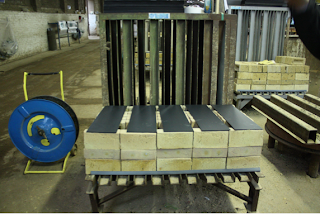

The factory was established in 1845
by Smeed and Dean and in the 1880's was the largest in Britain, producing 8 million
London stocks annually. At the
time, it was a huge employer in the area – building cottages and a church for
the workers near to the factory. Today the factory is run by the large company
Wienerberger and it is operated by a team of 35 employees who still live
locally, the factory produces 16-17 million bricks every year.
Each brick takes approximately 6 days to produce. Please find below some images from my visit.


Sunday, 13 January 2013
Carl Andre, Equivalent VIII, 1966

Carl Andre, Equivalent VIII, 1966
I went to the Tate Modern today to visit Carl Andre's brick sculpture Equivalent VIII, made in 1966 and purchased by Tate in 1972,
after which it sparked a lot
of controversy from the public.
"Carl Andre's Equivalent VIII has 120 bricks stacked 2 deep x 6 wide x 10 long. The
other equivalents in the series also have 120 bricks, identically aligned, may
be combined into 90 different cuboids, (induding the most compact) a stack 8 x
5 x 3 and (the least) the three single file rows along each of the dimensional
axes. Each of these 90 cuboids can in turn be set up on the floor in three
different ways. Thus there are 270 possible combinations. And looking down on
Equivalent VIII we may perhaps imagine looking up at Equivalent CCLXVII – a
single file vertical column of 120 bricks laid end-on-end, which would, if it
stood almost 30 metres above the ground"
– Tom Lubbock
Here is a clip from the documentary, Upholding the Bricks, produced in 1991
by Channel 4 and narrated by the British television
presenter - Raymond Baxter - who incidentally is also Carl Andre’s Uncle.
Wednesday, 12 December 2012
Bricks from Norwich

Subscribe to:
Posts (Atom)